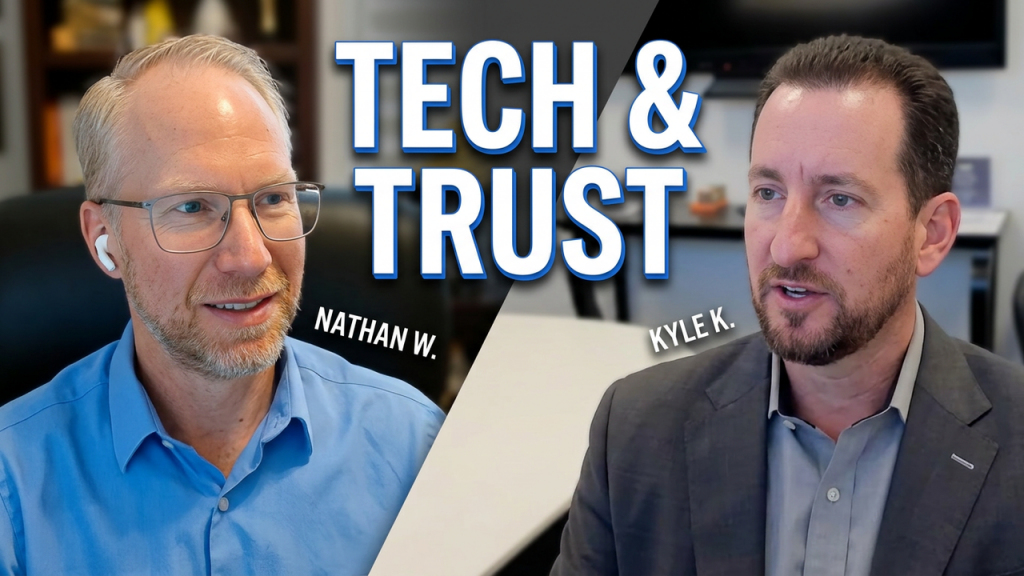
A YouTube podcast thumbnail featuring Nathan Whittacre on the left and Kyle Kirwan on the right, separated by a diagonal split-screen design. Large text in the center reads “TECH & TRUST,” highlighting the episode’s focus on technology, cybersecurity, AI, wealth management, and client trust.
Technology is changing the way we work, plan, invest, and protect our businesses. Some of those changes are exciting. AI can help teams move faster, improve communication, and reduce manual work.
But there is another side to it. Cybercriminals are getting smarter, scams are harder to spot, and business owners are being asked to make technology decisions in areas that are becoming more complex by the day. That is what this episode of Stimulus Tech Talk is all about.
Nathan Whittacre, CEO of Stimulus Technologies, sits down with Kyle Kirwan, co-founder of Cornerstone Wealth Management and a longtime Stimulus Technologies client, to talk about cybersecurity, AI, financial planning, client trust, cryptocurrency, and the role technology plays in protecting what people have worked so hard to build. It is a practical conversation between two business leaders who deal with these issues every day from different sides: financial planning and business technology.
Watch the full episode:
A Real Cybersecurity Scare
Kyle shared a story that should make every business owner pause. One of his clients opened what looked like a simple party invitation from a friend. It did not look dangerous, and it did not come across as an obvious scam.
But that invitation turned out to be malicious. The client’s device was compromised, and soon after, someone attempted to send a wire transfer for nearly $19,000 from the client’s account. Thankfully, the brokerage firm caught the transaction before the money left the account.
That is the scary part. This did not start with a dramatic breach or some complicated attack that only happens to huge companies. It started with one click on something that looked familiar.
Cybersecurity Is a Business Issue
When people hear the word “cybersecurity,” they often think about firewalls, antivirus software, or some technical problem for the IT department. For business owners, cybersecurity is much bigger than that. It affects your money, your clients, your reputation, and your ability to operate.
During the episode, Nathan shared that investment fraud and business email compromise accounted for more than $11.6 billion in reported losses in the U.S. That number is hard to ignore, and it is only based on reported losses. Many victims never report what happened because they are embarrassed, unsure where to turn, or do not fully understand the scope of the fraud.
For small and midsize businesses, this is one of the biggest takeaways from the conversation. Cybersecurity is not just a technical concern. It is part of protecting the business itself.
If your company uses email, online banking, cloud software, client records, remote access, or digital payment systems, you have exposure. The goal is not to avoid technology. The goal is to use it carefully and have the right protections in place.
AI Can Be Helpful When It Has a Clear Purpose
Nathan and Kyle also talked about AI and how it is showing up in wealth management. Kyle explained that his team uses AI-powered tools to improve communication with clients. After a client meeting, AI can help summarize the discussion, organize next steps, and make sure both the advisor and the client are clear on what happens next.
That is a practical way to use AI. It saves time, reduces confusion, and helps create a better client experience. But Kyle was also clear that AI is not a replacement for the human side of financial planning.
People do not just want an algorithm managing major life decisions. They want someone who understands their goals, concerns, family, retirement plans, and bigger financial picture. That same idea applies to business technology.
AI tools can help. Automation can help. Monitoring tools can help. They are most valuable when they are used with good judgment and guided by people who understand your business.
Not Every New Tool Belongs in Your Business
One important part of the conversation was the risk of adopting technology too casually. A new app may look useful, and an employee may find a shortcut that saves time. A team member may start using a tool for notes, files, scheduling, or communication without realizing it could create a security risk.
This is sometimes called “rogue IT.” It happens when software gets used inside a company without approval, review, or oversight. Most of the time, nobody is trying to do anything wrong.
But if that tool handles client information, financial records, private documents, or company data, it needs to be reviewed. A useful tool can still create problems if no one checks how it stores data, who can access it, and whether it meets your company’s security needs.
Before adding new technology, business owners should ask:
- Is this tool secure?
- Where does the data go?
- Who can access the information?
- Does it meet our compliance requirements?
- What happens if the platform is breached?
- Do we have control over the data if we stop using it?
Those questions are not meant to slow the business down. They are meant to prevent a bigger problem later.
The Human Side Still Counts
One of the best parts of this episode is the way Nathan and Kyle talk about relationships. Kyle’s business is built around helping people plan for retirement, protect assets, and make smart financial decisions. That kind of work requires trust.
Technology can support that trust, but it cannot create it by itself. The same is true for IT and cybersecurity. A business owner does not just need a dashboard, a ticket number, or another automated email.
They need a partner who answers the phone, understands the business, and helps solve problems before they become emergencies. That is especially important for companies that do not have a full internal IT department. Many small and midsize businesses are relying on an office manager, operations person, or “accidental IT person” to handle technology issues.
That can work for a while, but it becomes risky as the business grows. At some point, the business needs more than quick fixes. It needs a plan.
Cryptocurrency, Data Centers, and Digital Risk
The episode also touched on cryptocurrency and AI-driven data centers. Kyle was cautious when talking about cryptocurrency. He described it as speculative and reminded listeners not to invest in things they do not understand.
That advice is useful beyond investing. Business owners face the same kind of decision-making pressure with technology. New tools, platforms, and trends appear constantly.
Some are valuable, some are risky, and some are not a good fit for your business at all. Nathan and Kyle also discussed how AI is increasing demand for data centers and technology infrastructure. As more companies rely on AI, cloud tools, automation, and digital platforms, the behind-the-scenes systems become even more important.
The future of business will rely heavily on technology. That means security, planning, and smart decision-making will only become more important.
Simple Security Steps Business Owners Should Take
You do not need to become a cybersecurity expert to make better decisions. But you do need to take the basics seriously. Start with the protections that reduce the biggest risks.
For many businesses, that means:
- Use a password manager.
- Turn on multi-factor authentication for email, banking, cloud systems, and other important accounts.
- Train employees to slow down before clicking links, opening attachments, or responding to unusual payment requests.
- Use proper email protection, endpoint security, and backups.
- Create a clear process for approving new software.
- Make sure your team knows who to call when something feels suspicious.
The goal is not perfection. The goal is to make your business harder to attack and faster to recover if something goes wrong.
Watch the Full Conversation
This episode covers a lot of ground: cybersecurity, AI, financial planning, client relationships, cryptocurrency, data centers, and the risks that come with fast-moving technology. You will hear the full story of the attempted $19,000 fraud and how Kyle’s team uses AI in a practical way.
You will also hear why trust is still central to financial planning and what business owners should be thinking about as technology keeps changing. Watch the full episode of Stimulus Tech Talk to hear the complete conversation with Nathan Whittacre and Kyle Kirwan.
For more information about Cornerstone Wealth Management, visit https://cornerstonevegas.com/.
If you are concerned about your company’s cybersecurity, email protection, employee training, or overall business security, call Stimulus Technologies. We can help you identify your risks, protect your systems, and build a clear plan to keep your business secure.
Watch the full episode of Stimulus Tech Talk on our YouTube channel or listen on your favorite podcast platform.