


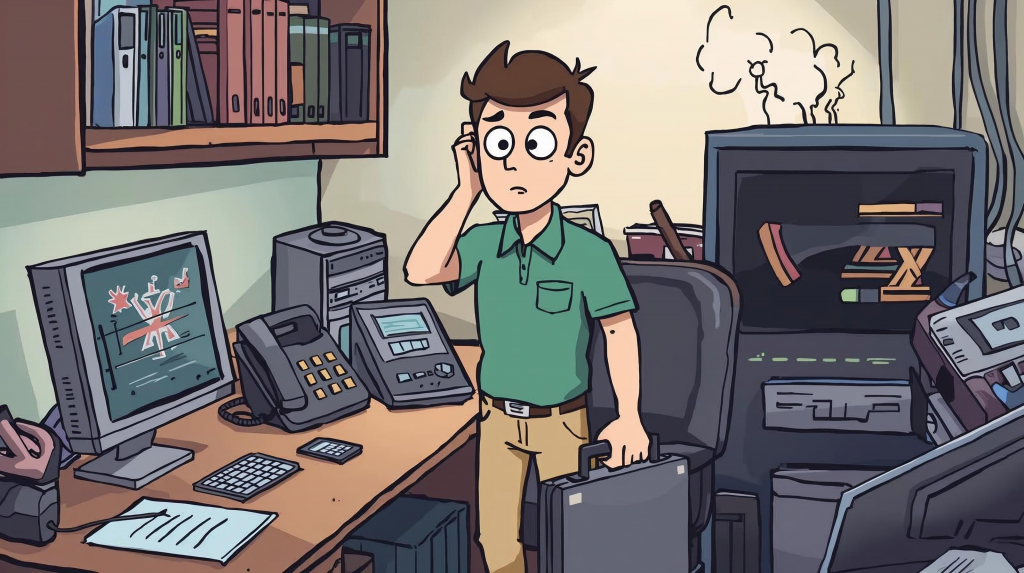
If you’re like most small and mid-sized businesses, there’s one person everyone turns to when anything breaks:
“Ask our IT person—they’ll know.”
It feels convenient… until you ask a tougher question:
What happens if that person quits, gets sick, or just stops answering?
Short answer:
If your entire IT setup lives in one person’s head, your business is one resignation away from serious downtime, lost access, and a lot of stress.
That’s exactly what we dig into on the Stimulus Tech Talk podcast episode:
“The Single IT Problem: Your Whole Business Can’t Depend on One Person.”
In this post, you’ll get the highlights, then you can listen to the full conversation for real stories, examples, and next steps you can use right away.
Watch Stimulus Tech Talk on YouTube or listen on your favorite podcast platform.
What Is the “Single IT Person” Problem?
The “single IT person” problem happens when one individual:
- Configures your network, email, and security
- Owns most of the admin logins and passwords
- Is the only one who understands how everything connects
It works… until it doesn’t.
If that person leaves suddenly, you may not know:
- Who owns your domain and DNS
- Where backups are stored or how to restore them
- Which vendors you rely on (or how to contact them)
In the episode, Nathan Whittacre shares real examples of companies that lost access to email, websites, or domains overnight because everything was tied to one person’s account.
Key Risks of Relying on One IT Person
Loss of Access to Critical Systems
When one person controls your domain, email, and cloud platforms, your business is exposed. If they leave on bad terms or simply forget to document things, you could be locked out of:
- Email and collaboration tools
- Website and DNS settings
- Security and backup systems
Recovering that access can take days or weeks—and every hour of downtime costs you money.
Domain and Email Disruptions
A common scenario: your domain is registered under your IT person’s personal email and credit card.
If that card expires or they walk away without handing it over, your:
- Website goes offline
- Email stops flowing
- Customers can’t reach you
On the podcast, Nathan explains how surprisingly hard it can be to fix this after the fact.
Security and Data Exposure
When IT is built around trust in one person instead of clear processes, you may have:
- Weak or undocumented password practices
- No proof that backups are actually restorable
- Limited visibility into who has access to what
Even if no one ever acts maliciously, the lack of structure is a big risk for a growing business.
Red Flags You’re Over-Dependent on One IT Person
In the episode, Sherry and Nathan talk through signs that your IT setup has become a single point of failure. A few to look for:
- “Don’t worry, I’ve got it” is the answer to most IT questions
- Important logins live in someone’s head or on their personal device
- You’ve never seen a backup report or tested a restore
- One person is doing everything: support, projects, cybersecurity, strategy
If a few of these sound familiar, you’re exactly who this episode was recorded for.
How Co-Managed IT Solves the Single IT Problem
One of the most helpful parts of the conversation is Nathan’s breakdown of co-managed IT—a model where your internal IT person works alongside a Managed Service Provider (MSP).
Instead of replacing your IT person, co-managed IT gives you:
- Backup and redundancy: If your IT person is out or leaves, the MSP already knows your environment.
- Documentation: Systems, passwords, and procedures live in company-owned tools—not just in someone’s head.
- Stronger security: An MSP brings mature tools and processes that are tough for one person to maintain alone.
- Project help: Big projects don’t stall because your IT person is buried in day-to-day tickets.
It’s a way to keep the responsiveness of in-house IT while eliminating the “all eggs in one basket” risk.
Quick FAQ: Single IT Person Risk
Is it okay for a small business to have just one IT person?
Yes—but only if:
- Credentials are documented and company-owned
- Backups and recovery are clearly defined and tested
- You have a plan for coverage when that person is unavailable
As you grow, partnering with an MSP becomes more important.
What should I do if I suspect we have this problem?
Start by:
- Listing all critical systems and who has admin access
- Moving domains and major accounts under company-controlled emails
- Implementing a secure, shared password manager
- Talking with an MSP about co-managed IT options
Nathan walks through these steps in more detail on the podcast.
Your Next Step: Don’t Wait for an IT Crisis
If reading this made you slightly uncomfortable, that’s a good thing—it means you’re aware of the risk before it becomes a crisis.
The best next step?
Listen to the full Stimulus Tech Talk episode.
You’ll hear:
- Real-world stories of IT people leaving and what happened next
- Practical questions to ask your current IT person or provider
- How to move from “single IT hero” to a stable, documented IT environment
Then, if you’re ready to explore co-managed IT or a more resilient support model, reach out to us for a conversation about your environment and options.