Most business owners do not spend their day thinking about cybersecurity compliance. They are focused on customers, employees, operations, and the hundred other things it takes to keep a company moving. So when compliance comes up, it often feels like one more burden to deal with later.
The problem is, later can get expensive.
In this episode of Stimulus Tech Talk, Nathan Whittacre talks through a question many business owners are asking right now: is cybersecurity compliance optional? The honest answer is that it depends. In some cases, it may feel optional at first. But if your business works with regulated industries, handles sensitive customer data, needs cyber liability insurance, or wants to win certain contracts, compliance can stop being optional very quickly.
Why cybersecurity compliance matters for small businesses
A lot of small and midsize businesses assume compliance is mainly a concern for large companies or heavily regulated industries. That assumption can create real problems.
You may not think your business falls under strict compliance requirements, but your customers, vendors, or insurance carrier may see it differently. A client may ask for proof that you have certain security controls in place. An insurance company may require stronger protections before renewing your policy. A contract may demand more documentation than you expected. That is usually the moment business owners realize compliance is not just a technical issue. It is a business issue.
When compliance stops being optional
Nathan explains that compliance often becomes mandatory because of the business relationships around you. Even if your company is not directly regulated, you may still be expected to meet certain standards if you work with organizations that are.
That is especially true in industries like healthcare, defense, finance, and any environment where customer data, financial information, or sensitive records are involved. You may also feel pressure from cyber insurance providers, who are becoming much stricter about what businesses need to have in place before they will offer meaningful coverage.
In other words, you may not wake up one morning and decide to become compliant. You may find that staying insurable, keeping a client, or winning a contract leaves you little choice.
How cyber insurance is changing the conversation
One of the biggest takeaways from this episode is how much cyber liability insurance has changed. In the past, businesses could often answer a few questions, sign an attestation, and move on. That is not where things stand now.
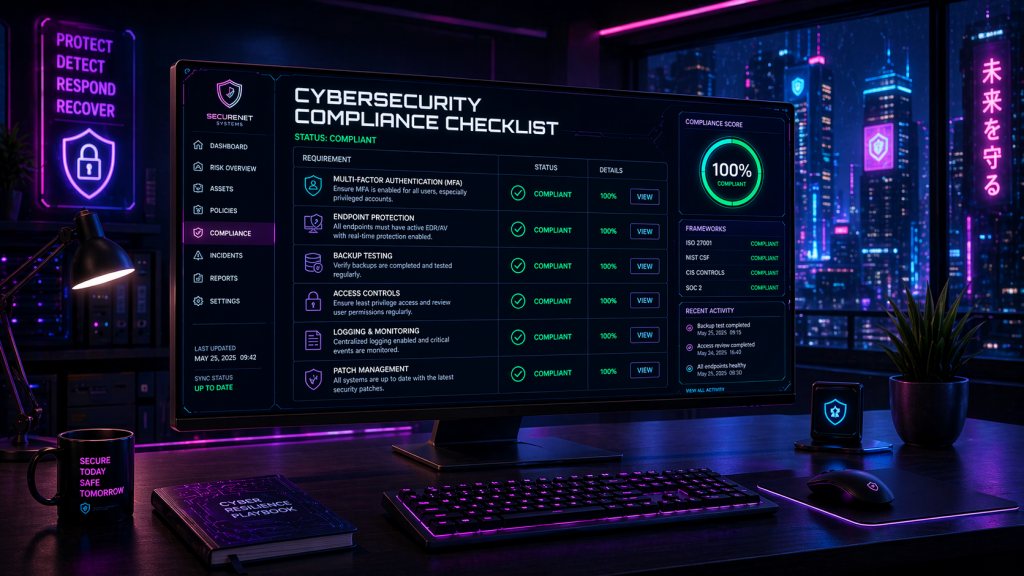
Insurance carriers are asking tougher questions and looking for proof. They want to know whether multifactor authentication is actually enabled, whether endpoint protection is in place, whether backup and disaster recovery plans exist, and whether security policies are documented and followed. If a business says it has those protections but cannot back them up, the consequences can be serious. Higher premiums, denied coverage, or denied claims are all on the table.
That makes compliance more than a box-checking exercise. It becomes part of protecting the business financially.
The real risk is bigger than fines
When people hear the word compliance, they usually think about audits, paperwork, and penalties. Those things matter, but they are only part of the picture.
The bigger risk is what happens when a business is not prepared. A cyberattack, ransomware event, financial fraud incident, or major outage can lead to downtime, lost revenue, damaged customer trust, and disruptions that are hard to recover from. For some companies, one serious incident can create a much bigger problem than any fine ever could.
That is why compliance is really about reducing risk. At its best, it helps a business put better safeguards in place before something goes wrong.
Common cybersecurity gaps businesses overlook
Another useful part of the episode is Nathan’s breakdown of the gaps businesses often miss. These are usually not dramatic, obvious failures. More often, they are everyday issues that get ignored until they stack up into something bigger.
Weak password habits, inconsistent multifactor authentication, too many users with admin access, untested backups, poor employee offboarding, and missing documentation are all common examples. On their own, each one may seem manageable. Together, they can leave a business exposed in ways the owner never intended.
That is part of what makes cybersecurity frustrating for so many companies. The risk does not always come from one giant mistake. It often comes from a collection of small gaps nobody addressed.
Where to start if you are worried about compliance
For business owners who suspect they may have gaps but are not sure where to begin, Nathan offers a practical first step: start with your cyber liability insurance attestation.
Go through it line by line and ask for proof. Can your team show that multifactor authentication is enabled? Can they verify endpoint protection across devices? Do you know who has administrative access? Have backups been tested? Are your policies written down, and are they actually being followed?
That kind of review helps move the conversation out of the realm of assumptions. Instead of saying, “I think we are covered,” you can start identifying what is in place, what is missing, and what needs attention first.
Why a cybersecurity assessment can help
For many businesses, the hardest part is not fixing the issues. It is knowing where the issues are in the first place.
A cybersecurity assessment can help uncover gaps, prioritize the biggest risks, and give business owners a clearer path forward. Instead of trying to sort through compliance requirements on your own, you get a practical look at where your business stands today and what changes would make the biggest difference.
That kind of clarity matters, especially when the stakes include insurance coverage, customer trust, and business continuity.
Watch the full episode
Cybersecurity compliance can feel confusing, especially when the rules are not always straightforward. But ignoring it does not make the risk go away. It just makes the surprise more expensive when it shows up.
Watch the full episode on our YouTube channel or listen on your favorite podcast platform to hear Nathan break down what compliance really means for small and midsize businesses, why more companies are being pulled into it, and what steps you can take now to avoid bigger problems later.