
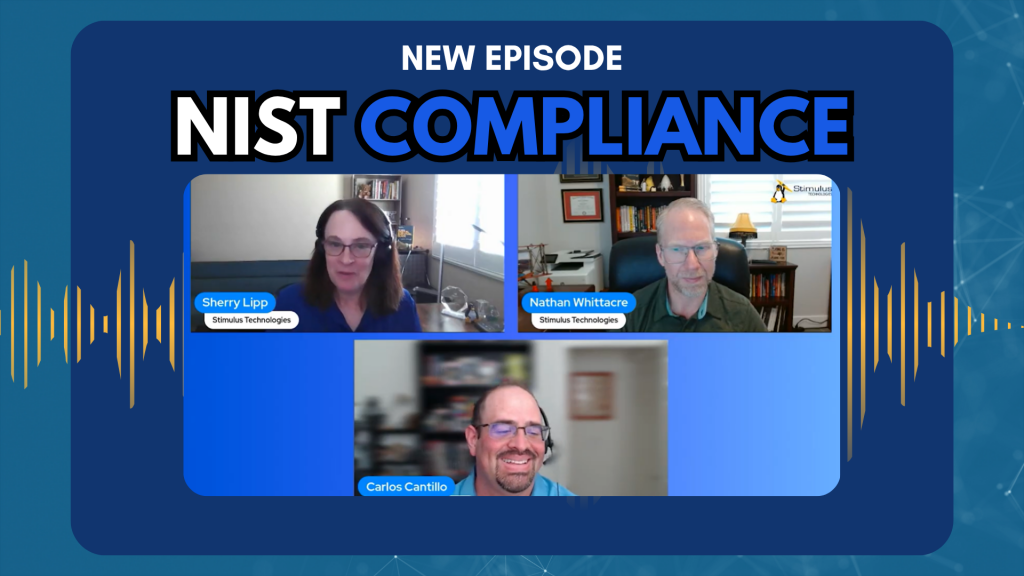
If you run a small business, you have probably heard more talk lately about compliance, cyber insurance, and cybersecurity standards. You may also be wondering whether any of it really applies to your company.
That is what makes this episode of Stimulus Tech Talk worth your time. Nathan Whittacre, Founder and CEO of Stimulus Technologies, and Carlos Cantillo, Security and Compliance Account Manager in Managed Security Services, break down NIST compliance in a way that makes sense for real business owners. Instead of burying the topic in jargon, they explain why NIST matters, why more companies are being asked about it, and what business owners should focus on first.
Why NIST is showing up more often
One of the biggest points Nathan makes is that NIST is no longer something only large enterprises or government contractors need to think about. More businesses are running into security requirements when they renew cyber liability insurance, pursue new contracts, or work with clients who want proof that good cybersecurity practices are in place. As Nathan says,
“It’s the most widely accepted security baseline that you can adhere to.”
That is why this conversation matters. Even if your company is not heavily regulated, the pressure to show stronger security is growing.
Carlos explains NIST in plain English
Carlos does a great job of making the concept feel approachable. He describes NIST as “a nice, easy, scalable way” for businesses to follow a recognized cybersecurity framework.
That is good news for smaller companies that do not have deep IT resources. NIST is not about making life harder. It is about creating structure so your business can improve security step by step instead of reacting after something goes wrong.
Where businesses should start
One of the most useful parts of the episode is how practical the advice gets. Carlos does not make compliance sound like some massive project that only big companies can handle. He brings it back to the basics:
“Start with MFA, get your patching done, test your backups, get your endpoint protection installed, and limit all your admin access.”
If you want the quick version, here are a few smart starting points:
- Turn on MFA for email, remote access, and admin accounts
- Keep systems patched and up to date
- Test backups so you know they actually work
- Use endpoint protection across devices
- Limit admin privileges to only the people who truly need them
That kind of advice is helpful because it gives business owners a starting line, not just a warning.
It is not just about tools
Nathan also makes an important point that many owners miss. Good cybersecurity is not only about having the right tools in place. It is also about having policies, following procedures, and being able to prove it if an insurance company, customer, or regulator asks.
Carlos sums that up well when he says,
“Policies are the rules… and then the procedures are the rules for playing that game.”
That simple line captures why documentation matters. It is not enough to say your business takes security seriously. You need a process behind it.
Why this episode is worth watching
What makes this episode so strong is the mix of leadership insight and practical guidance. Nathan brings the business-owner perspective, explaining why NIST is becoming more important and where the real risks show up. Carlos makes the topic easier to act on by explaining where to start and how businesses can make compliance manageable.
If you have been hearing more about NIST, cyber insurance, or compliance requirements and are not sure what they mean for your business, this episode is a great place to start. It is clear, practical, and focused on what matters most.
Watch the full episode of Stimulus Tech Talk to hear Nathan and Carlos break it all down in plain English. Watch on our YouTube channel, listen on Spotify or your favorite podcast platform.