Let’s face it—in a fast-moving city like Las Vegas, your dental practice depends on technology working perfectly every single day.
But here’s the reality most dentists don’t realize until it’s too late:
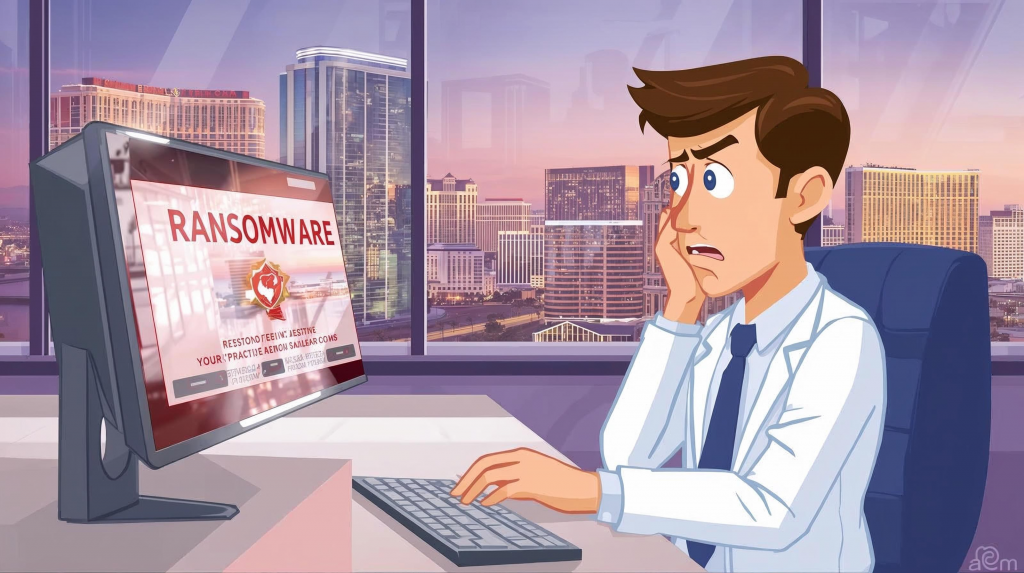
Dental practices are one of the top targets for ransomware attacks.
Why? Because you store highly sensitive patient data, rely on systems like Dentrix, and can’t afford downtime during patient hours.
Preventing ransomware isn’t about one tool—it requires a layered cybersecurity strategy, employee awareness, and proactive monitoring.
Most dental practices today invest in managed IT services costing $115–$180 per user per month, which typically includes ransomware protection, secure backups, and 24/7 monitoring.
Because without the right safeguards, a single attack can lead to:
- Days of downtime
- Lost patient records
- HIPAA compliance violations
- Damage to your reputation
And in Las Vegas… reputation is everything.
Quick Answer: Preventing Ransomware in Dental Practices
The most effective way to prevent ransomware is through a layered approach.
That includes:
- Endpoint security (protecting devices)
- Email filtering (blocking phishing attacks)
- Multi-factor authentication (MFA)
- Secure, tested backups
- 24/7 monitoring and rapid response
Most dental practices with 10–50 employees rely on managed IT providers to handle this proactively.
Because the truth is—ransomware doesn’t wait until it’s convenient.
And neither should your protection.
Why Dental Practices Are Targeted by Ransomware
I know how it feels here in Vegas—you’re focused on patients, not cyber threats. But attackers are paying attention.
Dental offices are prime targets for a few key reasons:
- You store protected health information (PHI)
- Many practices run on outdated systems or software
- Most don’t have in-house IT teams
- You rely heavily on systems like Dentrix and imaging software
- Even a few hours of downtime can cost thousands
And attackers know something else:
You’re more likely to pay quickly just to get back up and running.
That’s exactly what makes dental practices vulnerable.
The 5-Layer Ransomware Protection Framework for Dental Offices
If you take one thing from this article, let it be this:
Ransomware prevention is not one solution—it’s a system.
Here’s the framework every dental practice should have in place:
1. Endpoint Protection
This is your first line of defense.
Every computer, server, and device in your office should have:
- Advanced antivirus and endpoint detection
- Real-time threat monitoring
- Automatic isolation of suspicious activity
If one device gets infected, this prevents it from spreading across your network.
2. Email Security & Phishing Protection
Most ransomware attacks start with one simple mistake:
Someone clicks the wrong email.
Strong email protection includes:
- Spam filtering
- Malicious link detection
- Attachment scanning
- Ongoing employee awareness training
Because even the best technology can’t fix human error without training.
3. Multi-Factor Authentication (MFA)
Passwords alone are no longer enough.
Multi-factor authentication adds an extra layer by requiring:
- A code
- A device confirmation
- Or biometric verification
This protects:
- Email accounts
- Remote access systems
- Practice management software
Even if a password is stolen, attackers can’t get in.
4. Backup & Disaster Recovery
This is your safety net—and your last line of defense.
A proper backup strategy includes:
- Daily encrypted backups
- Secure offsite or cloud storage
- Regular testing to ensure data can be restored
Because if ransomware does get through…
Your ability to recover quickly is everything.
5. Security Monitoring & Response
This is where most dental practices fall short.
Cyber threats don’t happen on a schedule—which means protection can’t either.
You need:
- 24/7 monitoring
- Real-time threat detection
- Immediate containment and response
This is exactly why many practices partner with managed IT providers.
Because catching a threat early can mean the difference between a minor incident and a full shutdown.
Common Ransomware Risks in Dental Offices
Here’s the uncomfortable truth:
Most ransomware attacks succeed because of preventable issues.
The most common vulnerabilities include:
- Staff clicking phishing emails
- Weak or reused passwords
- No multi-factor authentication
- Outdated operating systems
- Unsecured remote access
- Lack of reliable backups
And it only takes one weak point to compromise your entire practice.
What Happens If a Dental Practice Gets Hit by Ransomware?
This is where things get serious.
When ransomware hits a dental practice, the impact is immediate:
- You lose access to patient records and schedules
- Appointments must be cancelled
- Revenue stops instantly
- Recovery costs can be significant
- You may face HIPAA violations and penalties
- Patient trust can take a long-term hit
And in a city built on reviews and reputation…
That kind of disruption can be hard to recover from.
Example: How One Las Vegas Dental Practice Stopped an Attack
Let me give you a real-world scenario that hits close to home.
A Las Vegas dental practice implemented:
- Endpoint protection
- Advanced email filtering
- Multi-factor authentication
- Secure, offsite backups
One day, a staff member clicked a phishing email.
But instead of spreading…
The system detected the threat immediately and contained it.
The result?
- No downtime
- No data loss
- No disruption to patients
That’s the power of layered security.
And more importantly—that’s peace of mind.
Key Takeaways: Preventing Ransomware in Dental Practices
- Dental practices are frequent targets due to sensitive patient data
- Most attacks start with phishing emails or weak security practices
- A layered approach is essential—not optional
- Managed IT services provide 24/7 monitoring and protection
- Preventing ransomware is far less costly than recovering from it
Why Las Vegas Dental Practices Choose Stimulus IT Services
I’ve worked with enough practices here in Vegas to know this:
You don’t want to become a cybersecurity expert—you just want your systems to be safe.
That’s exactly what Stimulus IT Services delivers.
- 30+ years supporting small and mid-sized businesses
- Supporting approximately 20 dental practices in Las Vegas
- 24/7 help desk and security monitoring
- Local technicians for fast onsite support
- Deep experience with Dentrix and dental workflows
- Cybersecurity built into every service plan
- Dedicated Technology Account Managers
At Stimulus, the mission is simple:
Protect your practice, eliminate downtime, and give you complete peace of mind.
So you can focus on what you do best—taking care of your patients.
FAQ: Dental Ransomware Protection
How do dental practices get ransomware?
Most attacks start with:
- Phishing emails
- Compromised passwords
- Unsecured remote access
Can ransomware be prevented?
While no system is 100% immune, most attacks can be prevented with:
- Strong cybersecurity tools
- Employee training
- Proactive monitoring
Do small dental practices need ransomware protection?
Absolutely. In fact, smaller practices are often targeted more because they may have fewer protections in place.
What is the best protection against ransomware?
A layered approach that includes:
- Endpoint protection
- Email security
- Multi-factor authentication
- Secure backups
- 24/7 monitoring
How much does ransomware protection cost for dental practices?
Most practices receive full protection through managed IT services costing $115–$180 per user per month.
If you’re wondering whether your practice is protected… that’s your sign to find out.
Schedule a discovery call with Stimulus IT Services and get a clear, no-pressure assessment of your risk.
Because in Las Vegas, the practices that stay secure…
are the ones patients trust most.