
AI works best when business leaders define the process, protect the data, and keep humans in control.
Artificial intelligence can help businesses save time, reduce repetitive work, and improve productivity, but only when it is built on the right foundation.
In this episode of Stimulus Tech Talk, Nathan Whittacre, CEO of Stimulus Technologies, talks with Joe Turso, CEO of Hive Point Group, about what businesses need to do before rolling out AI across the company.
The main lesson is simple: AI will not fix broken business processes. If a task cannot be done manually in a clear and repeatable way, it cannot be safely automated. Businesses need ownership, accountability, documented workflows, structured data, and measurable performance before AI can produce reliable results.
The conversation also covers one of the biggest risks facing businesses today: employees using unapproved AI tools. Shadow AI can expose sensitive company data, client records, financial information, and intellectual property. That is why companies need AI acceptable use policies, access controls, data loss prevention, and a clear plan for managing AI like any other business system.
AI is powerful, but it needs guardrails. The businesses that get the most value from AI will be the ones that combine automation with strong processes, secure platforms, and smart governance.
Ready to explore AI without putting your business data at risk? Download the free AI Jumpstart Guide from Stimulus Technologies and learn how to start with the right processes, policies, and guardrails.
Download the free AI Jumpstart Guide:
https://www.stimulustech.com/ai-jumpstart-guide/
Key Takeaways
- AI will not fix broken business processes. It will only speed up whatever process already exists.
- Businesses should document workflows before trying to automate them.
- AI works best when there is clear ownership, accountability, structured data, and measurable performance.
- AI should be treated like a junior employee. It can help, but it should not have unrestricted access to sensitive systems.
- Every business should have an AI acceptable use policy.
- Shadow AI is a growing risk because employees may use personal AI tools without company approval.
- Data governance, access control, and data loss prevention should be in place before AI is connected to business systems.
- Business owners should ask their IT provider how they are using AI and how they are protecting client data.
- AI should improve employee productivity, not simply replace people.
Why AI Will Not Fix Broken Business Processes
AI will not fix broken business processes because automation depends on repeatable, documented, and measurable work. If a company cannot perform a task consistently by hand, AI cannot safely automate it.
Joe explains it clearly in the episode: if you cannot do it manually, you cannot automate it.
That may sound simple, but it is one of the most important ideas for business owners to understand. Many companies want to jump straight into AI. They want faster reporting, automated workflows, better customer communication, smarter data analysis, and less manual work.
Those are good goals. But AI needs a clean starting point.
Before a business automates a process, it should be able to answer these questions:
- Who owns this task?
- Who is accountable for the result?
- Is the process documented?
- Can another employee follow the documentation and get the same outcome?
- Is the data structured?
- How will success be measured?
Without those answers, AI can create random results, inaccurate recommendations, poor analysis, and weak return on investment.
This is why AI implementation is not just a technology project. It is an operational project. Before AI can improve the business, the business has to understand how the work should be done.
The Four-Part Framework for AI Automation
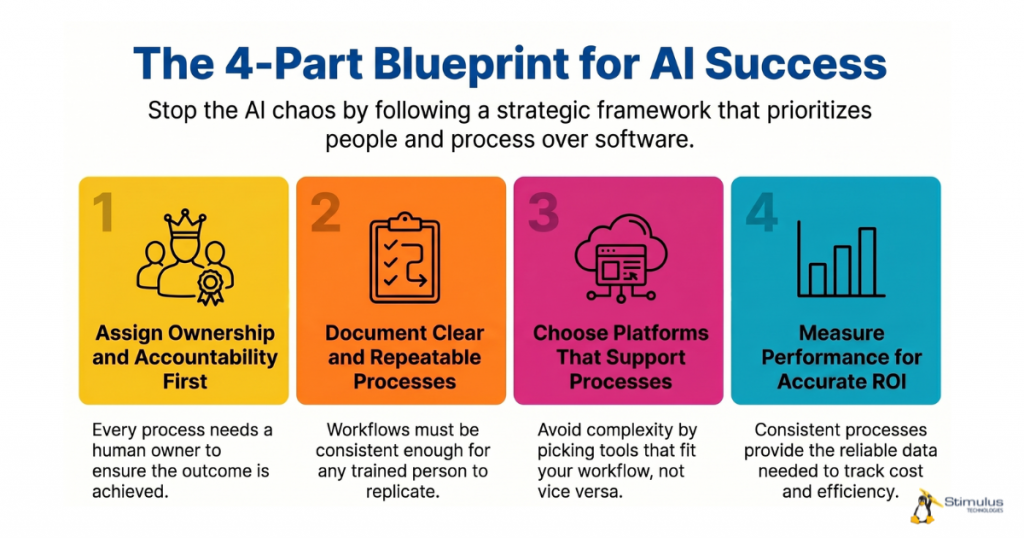
The 4-part AI success blueprint: start with people and process before choosing software.
A practical AI automation strategy should include people, process, platform, and performance because those four areas determine whether AI creates value or confusion.
Joe describes his framework as four parts: people, process, platform, and performance.
People come first because every process needs ownership and accountability. If no one owns the outcome, no tool will fix it.
Process comes next because the work must be documented and repeatable. A good process should be clear enough that another trained person can step in, follow the steps, and get the same result.
Platform means the technology must support the process. This is where many businesses get stuck. They buy software first and then try to force the business to fit the tool. That approach usually creates more complexity.
Performance is how the business measures whether the process is working. If the process is inconsistent, the company ends up measuring bad data. That makes it hard to understand cost, efficiency, productivity, and return on investment.
The right order is simple:
- Define the business objective.
- Document the workflow.
- Assign ownership.
- Choose tools that support the process.
- Measure performance over time.
That is how AI becomes useful instead of chaotic.
How Small Businesses Should Start With AI Automation
Small businesses should start AI automation by identifying the business outcome they want, documenting the current workflow, and deciding what experience they want customers and employees to have.
Joe explains that the first step is understanding the owner’s intent. What experience does the business want to create?
That question matters because AI should support the way the company wants to operate. It should not create a new mess on top of an old one.
For example, a small business may need to document processes for:
- Time cards and payroll
- Accounts receivable
- Customer onboarding
- Service requests
- Sales follow-up
- Project management
- Document storage
- Employee approvals
- Customer communication
These may not sound exciting, but they are the building blocks of automation.
Small businesses often struggle because many of these processes live inside someone’s head. The owner knows how things should work. A key employee knows the workaround. Someone else knows where the file is stored. But the process is not written down.
AI can help, but the first draft still has to happen.
The goal is not perfection. The goal is to get the process out of people’s heads and into a format the company can review, improve, and eventually automate.
How AI Can Help Document Workflows Faster
AI can help businesses document workflows faster by turning recorded conversations, meeting transcripts, and screen recordings into process maps, role descriptions, and step-by-step procedures.
One of the most practical examples from the episode is also one of the simplest: talk through the workflow.
Joe explains that he sits with clients, records the conversation, and has them walk through a process from start to finish. Then he uses AI tools to analyze the transcript and turn that conversation into useful documentation.
AI can help create:
- Step-by-step workflow documentation
- Roles and responsibilities
- Process summaries
- Visual workflow diagrams
- Handoff points between departments
- Improvement recommendations
- Draft standard operating procedures
This is a strong use case for AI because it solves a real business problem. Most companies do not struggle because they lack knowledge. They struggle because the knowledge is scattered, undocumented, or inconsistent.
AI can help turn that scattered knowledge into a usable first draft. From there, the team can review it, correct it, and decide what should be automated.
How Better AI Prompts Improve Business Results
Better AI prompts improve business results because they give the tool a clear role, goal, standard, and point of view. Vague prompts usually produce generic answers.
Nathan gives a helpful example from endurance training. If someone asks AI for a general Ironman training plan, the answer may pull from too many sources and create something that does not fit the person’s actual needs.
The same thing happens in business.
If you ask AI a vague question, you get a vague answer. If you give AI a clear role, context, and goal, the answer becomes much more useful.
Instead of asking, “How can we improve this process?” a business owner could ask:
- “Review this workflow and identify the top three bottlenecks slowing down service delivery.”
- “Review this process from the customer’s point of view and suggest three ways to reduce friction.”
- “Review this workflow and identify which steps are good candidates for automation.”
- “Review this procedure and identify where accountability is unclear.”
- “Review this process and recommend improvements based on operational efficiency.”
Joe also explains that he sometimes asks AI to review the same workflow from different perspectives, such as engineering, user experience, or efficiency.
That is where AI becomes more useful. It can help a business see the same process through multiple lenses.
Why AI Should Be Treated as Infrastructure, Not Just a Tool
AI should be treated as infrastructure because its real value comes from connecting business data, workflows, applications, and governance across the company.
Many business owners still see AI as a stand-alone tool. They use it to write emails, create content, summarize meetings, or brainstorm ideas.
Those uses are helpful, but they are limited.
Joe explains that AI becomes more powerful when it is viewed as infrastructure. In other words, AI should not be treated as a random app someone uses on the side. It should become part of how the business removes friction, analyzes information, improves workflows, and supports employees.
But that also means the risk is higher.
If AI is connected to company systems, it needs governance. It needs access controls. It needs data protection. It needs clear limits.
Without data governance, AI can become a security risk. It may access sensitive files, expose private information, or use data it should never have seen.
The more connected AI becomes, the more important security becomes.
That is why businesses need an AI roadmap, not just a collection of AI tools.
For many small and midsize businesses, this is where a trusted Managed IT Services provider can help. AI touches user access, Microsoft 365, cybersecurity, backups, endpoint protection, and long-term technology planning. It should not be managed as a one-off tool.
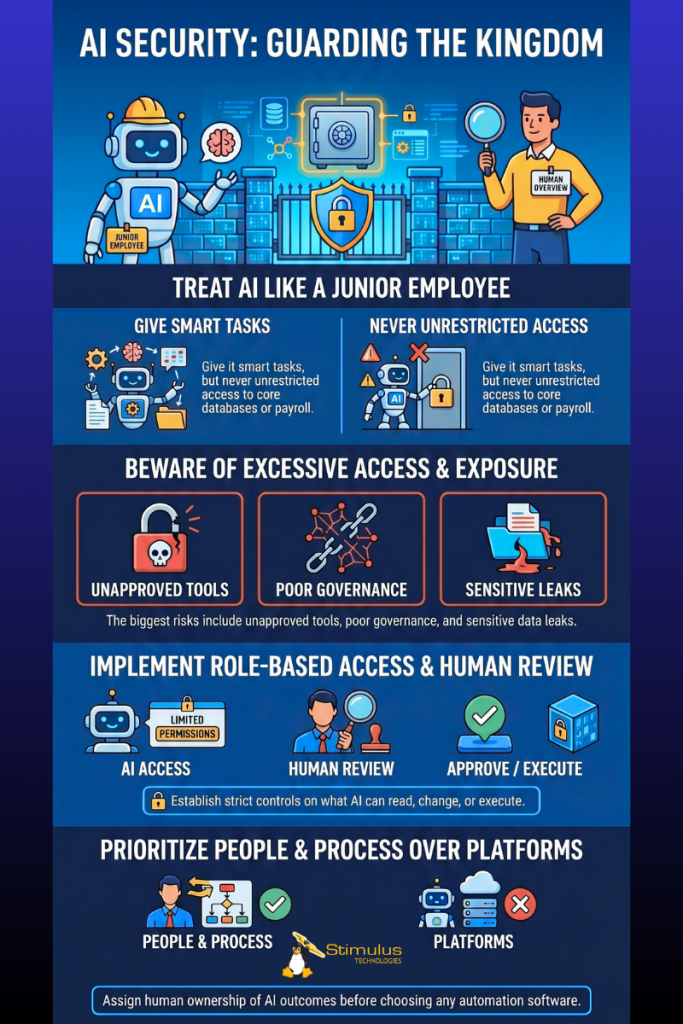
AI should be managed like a junior employee: useful, supervised, and limited to the access it truly needs.
What Are the Biggest AI Security Risks for Businesses?
The biggest AI security risks for businesses are excessive access, poor data governance, unapproved tools, sensitive data exposure, and allowing AI to act without human review.
Nathan and Joe discuss a key point in the episode: AI should not have the keys to the kingdom.
Joe compares AI to a junior employee. That is the right way to think about it.
A junior employee may be smart, helpful, and fast. But you would not give that person unrestricted access to bank accounts, payroll systems, production databases, customer records, and administrative controls on day one.
AI should be handled the same way.
Businesses need guardrails such as:
- Role-based access controls
- Data loss prevention
- Data classification
- Centralized context management
- Human review before major actions
- Limits on what AI can read, change, or execute
- Clear rules for sensitive data
- Monitoring for unusual activity
AI can do useful work, but it can also make mistakes quickly. The goal is not to avoid AI. The goal is to use it with the right controls in place.
Why AI Governance Starts With Policy
AI governance starts with policy because a business must define what should be protected, what employees are allowed to do, and how approved AI tools should be used.
When Nathan asks where a business should start with AI systems and automation, Joe gives a direct answer: policies.
That is the right starting point.
A company must first decide what it wants to protect. This may include customer data, employee data, financial records, intellectual property, passwords, regulated information, client files, and confidential communications.
From there, the company needs an AI acceptable use policy.
An AI acceptable use policy should explain:
- Which AI tools employees are allowed to use
- What types of data cannot be entered into AI tools
- Whether employees can use personal AI accounts for work
- Who approves new AI tools
- How AI-generated work should be reviewed
- What systems AI can and cannot connect to
- What happens if the policy is violated
But policy alone is not enough.
The business also needs enforcement. That may include approved platforms, endpoint controls, firewall rules, Microsoft 365 permissions, data loss prevention, employee training, and monitoring.
You would not give employees a handbook and assume they never need management. AI needs management too.
Not Sure Where to Start With AI?
Before you connect AI to your company data, make sure you understand the basics: what to automate, what to protect, and how to create safe usage policies.
Download the free AI Jumpstart Guide to get a practical roadmap for safer AI adoption.
Download the free AI Jumpstart Guide:
https://www.stimulustech.com/ai-jumpstart-guide/
How to Prevent Shadow AI in the Workplace
The best way to prevent shadow AI is to give employees approved AI tools that are safe, useful, and easy to use, while also restricting risky unapproved tools.
Shadow AI happens when employees use AI tools without company approval. This is becoming one of the biggest technology risks for businesses.
The employee may not mean to do anything wrong. They may simply want to work faster. They may use a personal AI account to summarize a document, write a proposal, analyze a spreadsheet, or clean up customer notes.
The problem is that sensitive business data may leave the company’s control.
Joe gives an example of a small company with about 15 users. Even though the company had approved AI tools, employees were also using several personal AI systems because they liked them.
That is the reality for many businesses. Employees will use the tools that help them get work done.
To reduce shadow AI, companies need two things:
- A safe approved option: Employees need an AI tool that is useful, easy to access, and connected to the right business knowledge.
- Clear enforcement: The company may need to block risky sites, restrict unauthorized tools, prevent workarounds, and control which platforms can access company data.
Security cannot only be restrictive. It also has to be practical. If the approved tool is worse than the personal tool, employees will look for a workaround.
What Business Owners Should Ask Their IT Provider About AI
Business owners should ask their IT provider how they are using AI, how they are protecting client data, and how they can help the business adopt AI safely.
Your IT provider already has deep access to your systems. That makes AI an important conversation.
Joe recommends starting with one direct question: Is my data safe?
That question applies to both sides of the relationship. First, business owners need to know how their IT provider is using AI internally. Second, they need to know how that provider can help them use AI safely inside their own business.
Business owners should ask their IT provider:
- Are you using AI to support our account, tickets, systems, or documentation?
- If so, what client data does AI have access to?
- Do you have an internal AI acceptable use policy?
- How do you prevent our data from being entered into public AI tools?
- Can you help us create an AI usage policy?
- Can you help us control shadow AI?
- Are our Microsoft 365 and SharePoint permissions ready for AI tools?
- What data governance steps should we take before connecting AI to our systems?
- How should we train employees on safe AI use?
This conversation should happen before AI becomes deeply connected to the business.
How AI Changes Employee Roles
AI changes employee roles by removing repetitive work and shifting people toward higher-value tasks that require judgment, customer service, strategy, and human interpretation.
One of the biggest concerns employees have is that AI will replace them.
Joe’s view is more practical. AI does not have to replace humans. When used well, it enhances them.
That does not mean every task stays the same. Some repetitive work will change. Some manual steps may disappear. Some roles may evolve.
But that can create a better employee experience if the business handles it the right way.
AI can help employees spend less time on:
- Repetitive data entry
- Manual reporting
- Basic documentation
- Routine research
- First-draft writing
- Repetitive internal requests
That gives employees more time for work that requires human judgment, customer relationships, strategic thinking, problem-solving, and industry expertise.
This is especially important for MSPs, law firms, accounting firms, consulting firms, and other professional service businesses. AI may help with the grunt work, but people still need to guide the work, interpret the results, and advise the client.
AI Implementation Checklist for Small and Midsize Businesses
A good AI implementation checklist should cover process documentation, data governance, approved tools, employee training, access controls, security monitoring, and human review.
Before rolling out AI across your company, use this checklist:
- Identify the business outcome you want AI to support.
- Document the current workflow before automating it.
- Assign ownership and accountability for each process.
- Confirm the process produces repeatable results manually.
- Clean up and structure the data AI will use.
- Create an AI acceptable use policy.
- Decide which AI tools are approved for business use.
- Restrict risky or unapproved AI tools.
- Apply role-based access controls.
- Use data loss prevention where appropriate.
- Require human review before AI changes important systems or sends sensitive information.
- Train employees on what data can and cannot be used with AI.
- Ask your IT provider how they use AI and how they protect your data.
- Measure performance, risk reduction, productivity, and return on investment over time.
AI is powerful, but it needs structure. The businesses that win with AI will not be the ones that buy the most tools. They will be the ones that build clear processes, protect their data, and help their people use AI responsibly.
Final Thoughts: AI Needs a Business Strategy, Not Just Another Tool
AI can help your business move faster, but speed only helps when you are moving in the right direction.
If your processes are undocumented, your data is unstructured, or your employees are using unapproved AI tools, automation can create new risks. But when AI is built on clear processes, strong policies, secure platforms, and human oversight, it can become a real business advantage.
Start small. Document the work. Protect the data. Give employees approved tools. Ask your IT provider the right questions. Then build from there.
Download our free AI Jumpstart Guide to learn how to begin using AI with the right processes, policies, and security guardrails in place.
Get the free AI Jumpstart Guide:
https://www.stimulustech.com/ai-jumpstart-guide/
Frequently Asked Questions
What is the biggest mistake businesses make with AI?
The biggest mistake businesses make with AI is trying to automate unclear or broken processes. If the workflow is not documented, repeatable, and owned by someone, AI will not fix it. It will usually make the confusion happen faster.
What is shadow AI?
Shadow AI is the use of unapproved AI tools by employees. This can happen when employees use personal ChatGPT, Claude, Gemini, or other AI accounts to complete work tasks without company approval. The risk is that sensitive business data may be exposed outside the company’s control.
Does every business need an AI acceptable use policy?
Yes, every business using AI should have an AI acceptable use policy. The policy should explain which tools are approved, what data cannot be entered into AI systems, who approves new tools, and how AI-generated work should be reviewed.
Should AI have access to company data?
AI should only have access to the company data it needs for a specific business purpose. Access should be limited by role, monitored, and protected with data governance controls. AI should not have unrestricted access to sensitive systems.
How should business owners start with AI?
Business owners should start by documenting key processes, identifying repetitive tasks, creating an AI usage policy, and reviewing data security. After that, they can choose tools that support the business strategy instead of buying random AI products.