


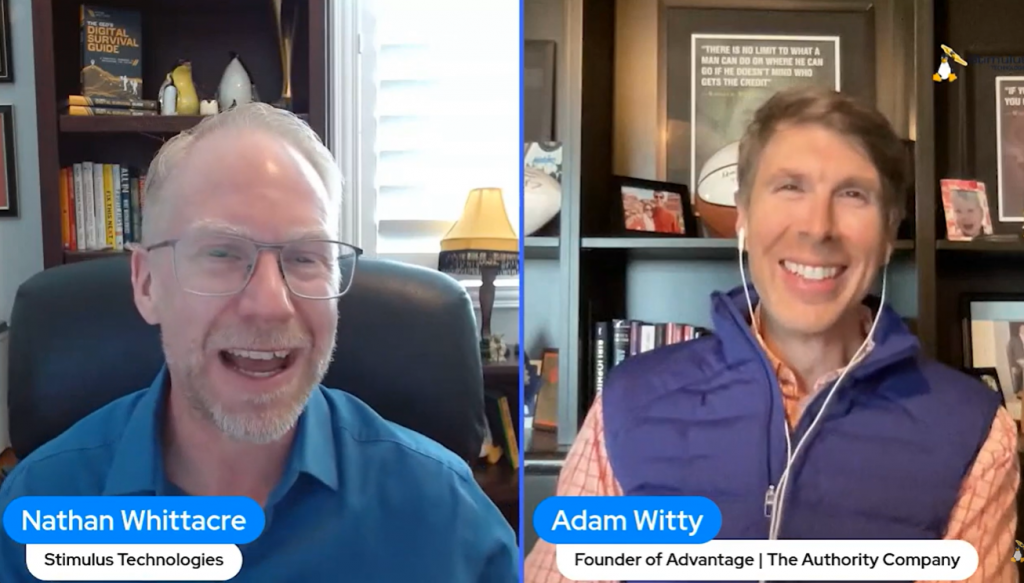
We recently released our 100th episode of Stimulus Tech Talk, and it felt like the right time to bring back a guest who had something meaningful to say about standing out in a noisy world.
Adam Witty first joined us in one of our early episodes, and we were glad to invite him back for this milestone conversation. A lot has changed since that first appearance, especially in the world of content, marketing, and AI, which made this a timely discussion to revisit.
In this episode, Nathan Whittacre sits back down with Adam Witty, founder and CEO of Advantage | The Authority Company, to talk about something a lot of business owners are trying to figure out right now:
How do you stand out in the age of AI?
That question goes beyond marketing.
AI is changing how businesses write, create, communicate, and publish. It is making content easier to produce, which can be incredibly helpful. We use AI tools too. But the more content that gets pushed into the world, the more obvious it becomes that volume is not the same thing as value.
That was really at the heart of this conversation.
There is more content than ever, but not all of it connects
One of the things Adam said in the episode that really stood out was this:
“Authenticity matters more than ever.”
That feels true.
We are living in a time when almost anyone can generate a blog post, a social caption, an email, or even the rough outline of a book in a matter of minutes. That is impressive. It is also creating a flood of content that often starts to sound the same.
Some of it is fine. Some of it is useful. But a lot of it feels flat.
➡️ It has information, but not perspective.
➡️ It has structure, but not experience.
➡️ It has words, but not much voice.
That is where real people still stand out.
What AI can help with, and where it falls short
We are not in the camp that says AI is bad and nobody should use it. That is just not realistic. It is a tool, and like most tools, it can be useful or misused.
In the episode, Adam made a point we agree with: AI can help frame ideas, organize content, and get a draft moving. But it still struggles with the things that make people pay attention for the long haul: story, emotion, lived experience, and a real point of view.
That matters even more in long-form content.
A short post can sometimes get away with being generic. A book cannot. A podcast conversation cannot. A talk in front of a room full of business leaders cannot. The longer people spend with your content, the easier it is to tell whether it came from someone who has actually lived it.
That is why this conversation matters so much right now. It is not really about whether AI is here to stay. It is. The better question is whether we are using it in a way that still sounds human.
Teaching is different than selling
Another idea from Adam that is worth repeating is this:
“Your intent has got to be to educate and to teach, not to sell.”
That is an important distinction.
People can tell when content is really just a sales pitch dressed up in a different format. We have all seen it. It is technically “content,” but it is really just advertising with a softer tone.
That does not build authority.
What does build authority is helping people understand something better. Showing them what to watch out for. Sharing what you have learned. Giving them insight that actually helps them make a better decision.
In our world, that matters a lot. Business owners are constantly dealing with technology decisions they may not have time to fully unpack. They do not need more noise. They need clarity. They need someone who can explain things plainly, help them think through risks, and offer practical direction.
That is part of what makes thought leadership actually work. Not just saying “look at us,” but saying “here is something useful.”
Authority is not about being loud
One of the themes in this episode is that authority is not the same thing as visibility.
A company can post constantly and still not be trusted.
Authority comes when people begin to associate your name with something specific and valuable. A clear idea. A real expertise. A point of view that holds up over time. Adam talked about the importance of choosing the word or phrase you want to own. That is a helpful way to think about it, because a lot of businesses try to be known for too many things at once. That usually leads to scattered messaging.
The better question is:
➡️ What do we actually want to be known for?
➡️ What do we want people to think of when they hear our name?
That kind of clarity makes everything else easier, content, branding, messaging, and even where time and energy get spent.
Why third-party credibility still matters
Another part of the conversation that stood out was Adam’s point about third-party validation. For a while, a lot of businesses put nearly all of their energy into owned channels: websites, social media pages, email lists. Those things still matter. But Adam made the case that being featured on trusted outside platforms matters even more now.
- Guesting on a podcast (want to guest on Stimulus Tech Talk? Send us a message)
- Public relations
- Industry publications
- Speaking opportunities
Why? Because it is one thing to say you know your stuff. It is another thing when someone else invites you to share it.
That outside credibility has always mattered, but it may matter even more now as AI search and recommendation tools try to sort out who is actually authoritative. Being referenced by trusted sources sends a stronger signal than simply publishing more content on your own.
A few practical takeaways for business owners
There were a lot of good ideas in this episode, but a few stand out as especially useful right now.
1. Decide what you want to be known for
Do not try to own everything. Pick the word, phrase, or area of expertise that fits your business and experience. Clarity beats cleverness.
2. Use AI to support your voice, not replace it
AI can help with drafts and structure, but it still needs human judgment. It needs stories, examples, and perspective. Otherwise it starts to sound like everyone else.
3. Focus on being useful
Content works better when it teaches. If it helps someone think more clearly, avoid a mistake, or understand a problem better, it is doing something worthwhile.
4. Build credibility beyond your own website
Do not just publish on channels you control. Look for ways to show up on podcasts, in articles, in industry publications, and in conversations that already have trust.
Why this episode is worth watching
What made this conversation valuable is that it was not hypey. It was not “AI will solve everything,” and it was not “AI is ruining everything.” It was a more grounded conversation about what still matters when technology changes.
And really, that is the point.
Tools will change. Platforms will change. Search will change. The way people find content will keep changing too. But trust is still trust. Credibility is still credibility. And authenticity still matters. Or to put it more simply: people can tell when something is real. That is why this episode is worth your time, especially for business owners, CEOs, and leaders who are trying to stand out without simply adding more noise.
Watch the full episode
Watch the full episode with Adam Witty on our YouTube channel here (or listen to Stimulus Tech Talk on your favorite podcast platform):
https://youtu.be/ZX5JPClOEEQ?si=7AfGHbvRAcUeCTud
It is a strong conversation on authority, authenticity, thought leadership, and what AI can’t fake.